Sample No. 0064
Android Scam Protections Expand to More Devices, With New Call and Screen Sharing Safeguards
Google is extending scam alerts across Android and adding protections for shared screens and call forwarding, with availability varying by feature.
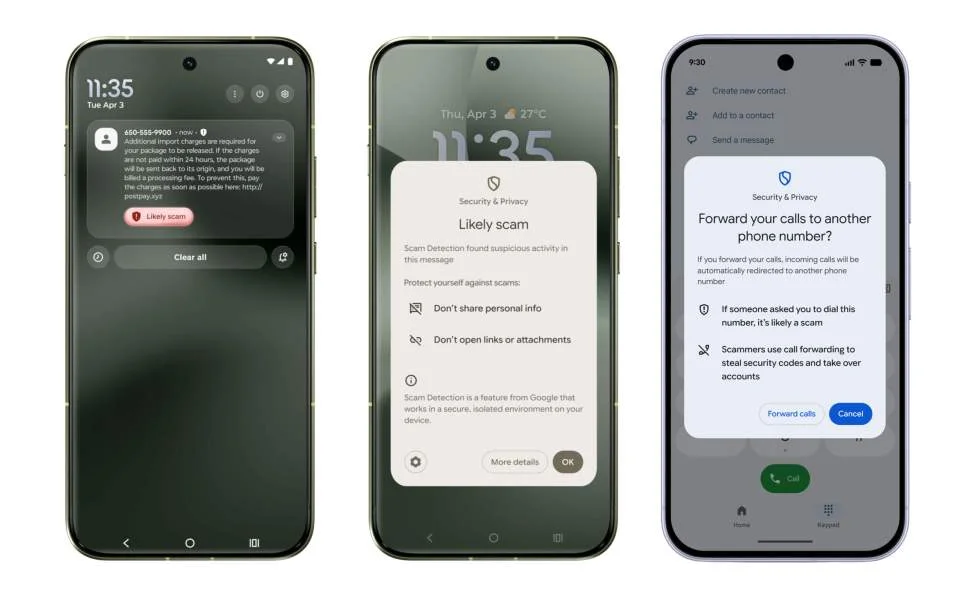
Android’s latest scam defenses target three points where attackers can gain an advantage: suspicious notifications, access to sensitive information during a shared screen, and call forwarding that can divert one-time passcodes. The changes extend Google’s existing notification alerts beyond Pixel phones and add protections for more devices, though the rollout timing differs by feature.
Google says notification scam alerts will reach hundreds of millions of additional Android users later this year. The company is working with HONOR, Infinix, iQOO, itel, JOVI, Motorola, OPPO, OnePlus, realme, TECNO, vivo, and Xiaomi to bring the alerts to their devices. That makes the expansion a matter of device-maker support as well as Android availability: users will need a compatible device, and the announcement doesn’t identify every model that will receive the feature.
Alerts appear where suspicious messages arrive
Scam Detection notifications look for suspicious activity within a notification. When Android identifies a likely scam, it can show a warning labeled “Likely scam.” Tapping the alert provides more context, giving users a chance to assess the notification before acting on it.
The useful change is the wider reach. A warning built into the notification flow can meet people at the moment they’re deciding whether to open a message, follow an instruction, or share information. The source doesn’t explain which signals the detection system uses, how it handles false alarms, or whether users can adjust the feature. Those details will matter in practice: a warning is most helpful when it’s clear why it appeared and doesn’t regularly interrupt ordinary messages.
Google first introduced these alerts on Pixel phones. Bringing them to devices from a range of Android makers could make the protection available to a much broader group, but the announcement describes a planned expansion rather than immediate availability across every model or region. “Later this year” is the timing Google gives for the notification alerts.
Screen sharing gets privacy barriers
A separate safeguard addresses live screen sharing. When a user shares their screen through Chrome or WebView, Android will automatically black out login fields and payment screens. The aim is to keep credentials and payment details from appearing to someone watching the session.
This matters because a person can be tricked into sharing a screen while signing in or completing a payment. Masking those fields adds a protective layer even if the user has already started sharing. It also works differently from a notification warning: instead of asking the user to judge a suspicious message, the system is intended to conceal selected sensitive content during the session.
The stated coverage is specific to Chrome and WebView, and Google hasn’t described how the feature identifies every login or payment screen. That leaves practical questions about which pages it can recognize and what happens when an app or site presents sensitive information in an unusual way. Users should also expect that blacking out a field may make it harder for a helper to guide them through a legitimate sign-in or payment while viewing the shared screen.
Call forwarding gets new checks
Google is also adding safeguards against apps redirecting incoming calls in the background. Call forwarding can be abused to send calls to another number, potentially exposing one-time passcodes delivered over the phone or helping an attacker take over an account. Android will be able to block apps from setting up that forwarding silently in the background.
The phone can also warn users when they try to enter an MMI forwarding code in the dial pad. These codes are used to control call forwarding, so an unexpected request to type one can be a sign that someone is trying to redirect calls. A warning at that point gives users a chance to stop and reconsider before changing how incoming calls are routed.
Google says the call-forwarding protections will begin rolling out in early December to Pixel phones and other select devices. The announcement doesn’t name those additional devices or specify whether availability will depend on a particular Android version, carrier, or region. That information will determine how widely users can rely on the safeguards.
What to watch as the rollout begins
The three measures address different stages of a scam: recognizing a suspicious notification, limiting what a viewer can see during a shared screen, and preventing or flagging call redirection. Together, they place more of the response inside Android’s normal interactions, where a user can encounter a warning or protection while handling a message, sharing a display, or using the dial pad.
For device owners, the immediate question is availability. Notification alerts are planned for a broad set of manufacturers later this year, while call-forwarding protections have a separate early-December rollout for Pixel and selected devices. Google hasn’t provided a model-by-model schedule, detailed detection rules, or performance figures. As the features arrive, compatibility and the clarity of their prompts will show how much protection users can expect in everyday use.
The original Google Messages coverage discusses a separate scam-defense update. Google’s details on these Android protections are available here, and the source report is at Droid Life.