Sample No. 0062
Google Universal Cart Brings Shopping and Checkout Into Search
Google’s Universal Cart brings product discovery, checkout and price tracking into Search, with an initial group of major retailers set to join soon.
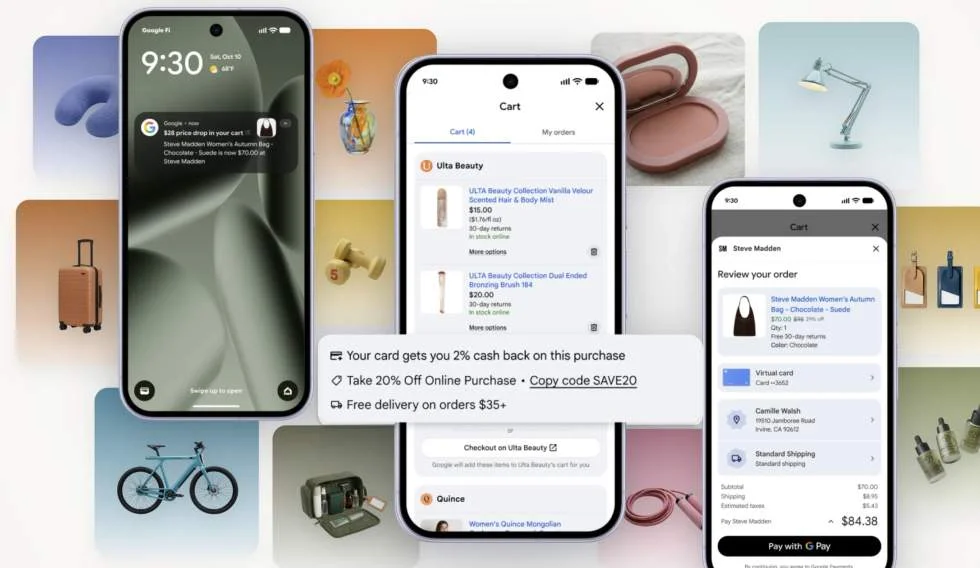
Google’s Universal Cart moves a meaningful part of online shopping into Search: shoppers can find products, add them to a cart and pay through Google, without necessarily visiting a retailer’s website. The feature is rolling out in the US, following its introduction at Google I/O. Its practical value will depend on how much of the shopping journey it can handle and how clearly it connects shoppers to the retailers fulfilling their orders.
The launch is planned with a group of well-known brands, including Nike, Sephora, Target, Ulta Beauty, Walmart, Wayfair, Fenty and Steve Madden. Google says those retailers will join “soon.” The source doesn’t provide a launch schedule for each brand, explain which products will be available, or specify whether all shoppers will see the same experience. Those details will matter: a cart that covers only selected items or retailers could be useful for some purchases while leaving shoppers to manage the rest elsewhere.
Search becomes part of the transaction
Until now, product discovery through a search engine has generally led shoppers to a retailer’s own shopping experience to complete a purchase. Universal Cart changes that handoff. Google describes a flow in which people can shop through Search, collect items in a cart and check out there. A retailer’s website may still be an option, but it isn’t required for every purchase in the experience Google outlines.
That puts Google closer to the point where product interest becomes an order. For shoppers, fewer transitions may make it easier to act on a purchase while comparing or researching products. For retailers, the trade-off is less direct control over the path between search results and checkout. The source doesn’t spell out how order management, customer service, returns or retailer account details will work, so the amount of work that remains with each brand is still an open question.
Those unanswered details are central to evaluating the feature. A shared cart can simplify shopping only if shoppers understand which retailer is selling an item, what happens after payment and where to go when an order needs attention. The article provides no information about delivery options, fees, loyalty programs or how product availability will be handled. These are practical parts of buying, not minor finishing touches, and they’ll shape whether shoppers trust the new flow for more than a quick purchase.
Price history adds a comparison tool
Google is also adding price tracking, including notices when prices drop and a view of price history. That gives shoppers another reason to stay in Search while considering a product: they can follow changes in price without relying only on the number shown at the moment they find it.
Price history can help put a current offer in context, while drop notices may be useful to people who are willing to wait before buying. The source doesn’t describe how long prices are tracked, how often the information is updated, or whether the history covers every retailer and product. Those limits will determine how well the feature supports comparisons across stores. A record that covers only part of the market could still help with timing, but it wouldn’t answer every question about where to buy.
The value depends on coverage and control
For shoppers, the clearest promise is convenience: product discovery, a shared cart, payment and price information gathered within Google’s shopping experience. The payoff will depend on whether the brands they use participate and whether the details needed to complete and manage an order are easy to find. People who prefer a retailer’s own checkout may also want to know when Google offers a choice to leave Search and buy directly from the brand.
For retailers, appearing in the experience may put products in front of shoppers without requiring them to finish the purchase on a brand’s own site. The article doesn’t explain the commercial terms, the product data retailers must provide or what customer information each party receives. Without those details, the effect on retailer economics is hard to assess. Google’s role in checkout could change how customers reach a brand, but the source doesn’t establish how much of the transaction a retailer can shape or what happens when an order goes wrong.
Universal Cart is a notable expansion of what shopping in Search can cover, but its announcement leaves important parts of the buying experience unspecified. The useful signals to watch are which products and retailers appear, how the handoff works when shoppers need help, and how price tracking presents its history. Those details will show whether the cart becomes a dependable way to shop across brands or remains a convenient option for a narrower set of purchases.
Read the original post: Google’s Universal Cart is Here