Sample No. 0019
Meta Deploys Media over QUIC for Instagram Live Ingest at Scale
Instagram Live now uses MoQ on iOS and Android, matching its previous transport on streaming quality and reliability while setting up broader changes.
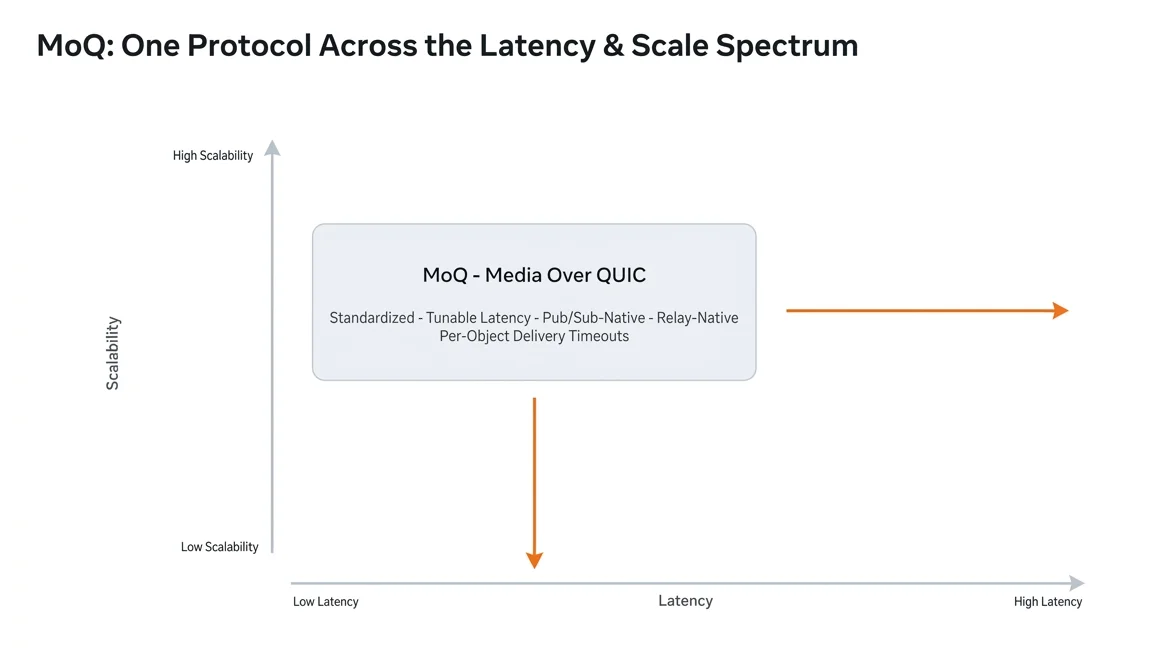
Meta has deployed Media over QUIC (MoQ) for Instagram Live video ingest on iOS and Android. The first goal was deliberately narrow: match the streaming quality and reliability of the existing transport, RUSH, while moving a major production workload onto an open protocol. That parity gives Meta a working base for exploring lower latency, better behavior on unreliable networks, and a shared transport for more live and interactive services.
The deployment also changes how Meta can develop its streaming infrastructure. RUSH was built and operated primarily within Meta. MoQ is an emerging standard developed through the IETF, with participation from Meta, Google, Akamai, Cisco, Cloudflare and academic researchers. That means implementation experience can feed into a shared specification and interoperability work, rather than leaving one company to evolve the protocol largely by itself.
One transport for more kinds of media
Streaming systems have accumulated different protocols for different jobs: RTMP for ingest, HLS and DASH for playback, and WebRTC for real-time calls. Meta also developed RUSH for use cases that did not fit neatly into those categories. That specialization works, but it gives engineering teams separate transport stacks, serving systems and operational practices to maintain. A person who starts a live stream and then makes a voice call in the same app can cross several of those boundaries.
The boundaries are becoming less clear as live video, real-time AI and generative creation tools meet in the same products. A shared transport could reduce the number of custom systems teams need to operate and make it easier to carry improvements between use cases. That’s the architectural case for MoQ; the Instagram deployment tests whether the protocol can handle a demanding workload in practice.
MoQ organizes media as addressable Tracks made up of media objects. Publishers send those objects, and subscribers receive them through relays. A relay can cache and forward objects without interpreting the underlying audio or video: it needs to understand MoQ’s framing and delivery metadata, not the media payload itself.
Its foundation is QUIC, which lets independent streams make progress without the cross-stream blocking associated with TCP. QUIC also supports faster connection setup and connection migration. Meta says its earlier QUIC deployment reduced request errors, tail latency and video stalls compared with HTTP/2. MoQ brings that transport foundation to live and interactive media, and can benefit from future QUIC features such as forward error correction.
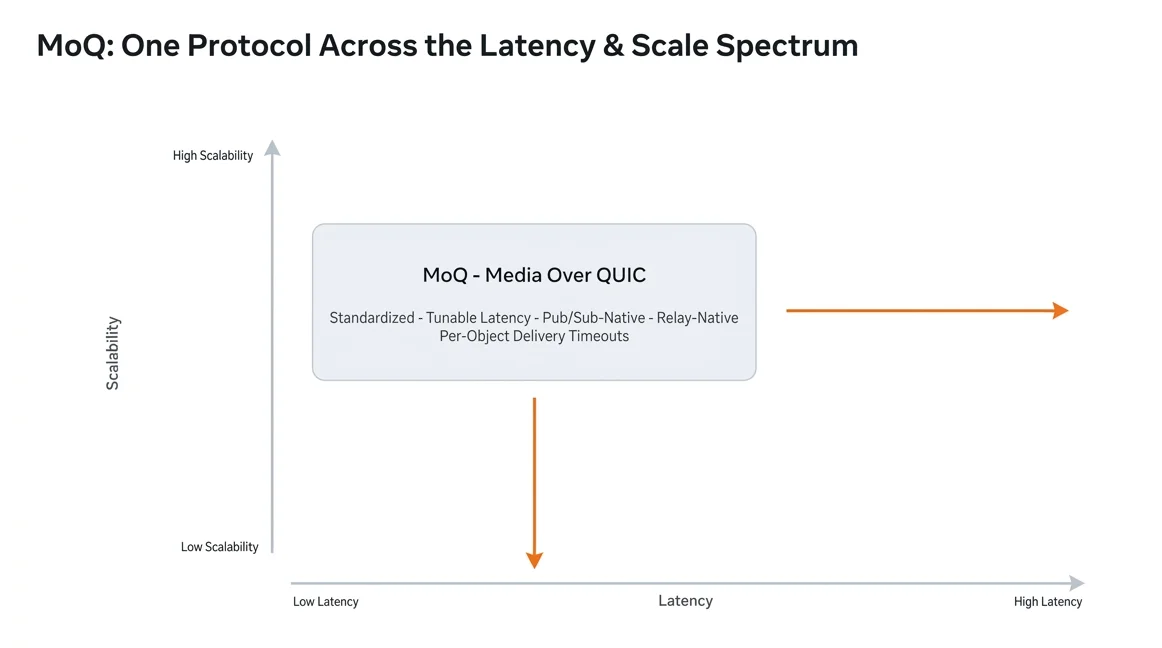
MoQ also builds scaling and media controls into the protocol design. Relays can cache content, combine requests for the same stream and fan out delivery to many subscribers. Those techniques already exist in live streaming systems, but MoQ treats them as core parts of the transport, with a design intended to scale through relays more efficiently than traditional HTTP streaming.
Delivery can be tuned by subscriber. Someone participating interactively might receive a track at around 100 milliseconds, while another service could accept several seconds of delay for buffering or archiving. Relays can use track metadata to prioritize, drop or replay objects when networks are congested. Tracks and quality variants are also represented directly, giving adaptive bitrate logic native protocol structures to work with.
QUIC availability remains a practical constraint. Some enterprise and carrier networks block or limit UDP on port 443. MoQ can use a standardized TCP mapping, such as WebTransport over HTTP/2 or the emerging QMUX mapping, to support networks where QUIC cannot pass. That fallback is still part of the work ahead for Meta’s deployment.
Why start with Instagram Live ingest
Instagram Live was a demanding place to begin: it serves users at Meta scale, and its ingest workload exercises the protocol’s ability to carry live media reliably. Meta also had nearly a decade of production experience with RUSH, its QUIC-based successor to RTMP. RUSH showed that QUIC could support live video at scale and informed the company’s decision to adopt MoQ.
Parity was the release bar. If MoQ could operate on Instagram’s largest live surface without degrading the measures used to assess streaming quality and reliability, Meta would have a baseline for testing other changes, including playback. The company reports that, after months of experimentation on iOS and Android, the MoQ path matched RUSH on those rollout measures. It describes the deployment as one of the industry’s largest MoQ uses by ingest stream count and total volume, though it provides no figures for either.
Changing the transport without rewriting the pipeline
Switching the ingest protocol affects more than the broadcaster app. The client must speak the new transport, backend systems expect familiar framing, and rollout controls need to support a quick reversal. Meta addressed those constraints by keeping the client change separate from a broader backend rewrite.
The apps use a MoQ publisher built on moxygen, Meta’s open-source MoQ library. It supports publisher, subscriber and relay roles, connects to Meta’s QUIC stack, mvfst, and provides hooks for custom media handling. A configuration setting selects MoQ or RUSH for a broadcast.
At the network edge, dedicated endpoints terminate MoQ connections and translate MoQ frames into the RUSH format expected by the existing backend. This lets the team change the client transport while downstream systems continue to receive the format they already handle. Meta describes the translator as temporary: once the backend consumes MoQ natively and MoQ becomes the sole ingest path, the conversion layer can be removed.
Routing is controlled on the server. Stream URL generation directs eligible broadcasts to endpoints that support MoQ, based on experiment group. That allows Meta to adjust the rollout in minutes without waiting for a particular share of users to install a newer app version.
Deployment lessons and next steps
The MoQ specification was still changing during development. Meta pinned implementations to particular draft versions, maintained compatibility shims for older clients and contributed changes to the IETF effort. For networks that restrict UDP/443, the service chooses TCP or QUIC at the start of a live session, based on which connection handshake succeeds, and keeps that choice for the session.
Debugging encrypted QUIC traffic presented another challenge. Packet captures and network middleboxes cannot see MoQ framing in the usual way, so Meta added MoQ-aware tracing at the edge. That provides visibility into individual media-object events without requiring the transport to expose its encrypted contents.
The next steps include extending MoQ to more Meta apps and using subgroups to carry audio, video and metadata on separate streams, which could improve resilience when packets are lost. Meta also plans to move from RUSH’s existing TCP fallback toward QMUX, a standardized mapping that would remove the current fallback dependency and eventually make it possible to retire RUSH.
Playback is another prospective step. In an end-to-end MoQ architecture, media could be pushed as it is produced. Partial reliability could let a player skip stale video after loss rather than accumulating delay, while adaptive bitrate logic could lower resolution to preserve continuity as available bandwidth changes. These are architectural possibilities Meta is exploring, not outcomes established by the ingest rollout.
Meta is also investigating whether a low-latency, bidirectional transport could carry signaling and media together for real-time AI services. Meeting those workloads’ latency, loss-recovery and media-quality needs remains open work. The Instagram result establishes a production baseline; broader rollout, native backend support and TCP fallback will show how far MoQ can consolidate Meta’s media systems.
Meta presented this work at DEMOQED 2026. The MoQ Transport IETF draft and the moxygen library provide further technical detail. Related background on Meta’s QUIC rollout is available in Meta’s account of bringing QUIC to its services; RUSH is described in the RUSH draft.
The post Shipping Media Over QUIC at Meta Scale for Instagram Live Ingest appeared first on Engineering at Meta.
===