Sample No. 0014
Why Shift-Left Process Control Is Straining Semiconductor Fab Data Systems
Real-time sensor analysis can catch yield risks sooner, but fabs must preserve the context that connects process steps and keeps models useful.
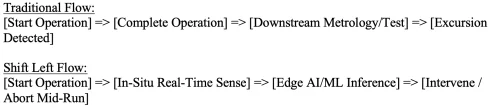
Moving yield detection into the process module can give semiconductor fabs a faster response to process drift. It also changes the data problem: models need fine-grained equipment signals in time to influence a running process, while manufacturing teams still need connected, trustworthy records to understand how one step affects the next.
That tension is becoming harder to manage as fabs collect more sensor readings, inspect more sites and analyze raw traces instead of summaries. In some cases, annual data volumes reach hundreds of petabytes. The practical question is no longer just how to gather useful signals. It is how to process them quickly without losing the context needed for decisions across a factory.
Earlier detection means more data, sooner
For years, yield problems often became visible only after later screening, such as electrical test. By then, a process excursion may have affected additional wafers. Shift-left methods bring detection closer to the operation itself: AI and machine-learning models examine equipment data as a process runs, flag suspicious behavior and can inform an adjustment or a stop. That can shorten the feedback loop from days, weeks or months to near real time.
Intel Foundry’s Ashish Gupta says equipment data has grown exponentially over the past five years as fabs have adopted in-situ process control. Onto Innovation’s Jae Yong Park describes three drivers: equipment now exposes hundreds of parameters, readings arrive at intervals of tens of milliseconds rather than roughly once a second, and engineers increasingly work with raw traces rather than summarized values.
Each change adds a different burden. More parameters increase the range of signals to manage. Faster sampling increases the arrival rate. Raw traces retain details that summaries discard, but require more storage and processing. In combination, they expand the volume, velocity and variety of factory data. Module-level analysis may need results in less than a second, leaving little time to move data to a distant system and wait for a response.
The equipment itself can generate far more information than a fab can usefully collect. Synopsys’ Kartik Venkataraman points to radio-frequency plasma sources in etch and chemical vapor deposition tools. A source may operate at megahertz frequencies, while pulsing happens at kilohertz rates. Each pulse has a waveform, with transient behavior and other features that may contain clues about the process. Capturing every pulse would mean handling megabytes of data per second.
Access is also incomplete. Equipment makers may retain some signals as proprietary information, while fabs may lack the infrastructure to handle the full output. That makes data selection part of the engineering task: teams need to identify which measurements can reveal actionable process changes, and which can be compressed or summarized without removing a useful signal.
What shift-left control changes inside a fab
Earlier testing has long been used to improve confidence in finished products. Wafer-level screening can catch problems before final testing, and chiplet manufacturing has added testing of separated dies to help identify known-good components. The shift in fab process control follows a similar logic, but applies it to equipment behavior and material quality while manufacturing is underway.
In a process module, the basic loop has three parts. First, an inference model reads sensor data as the equipment operates. It then identifies behavior that may put the wafer at risk. The fab can respond by changing tool settings, or by stopping the operation so engineers can investigate. If the model flags a problem, root-cause analysis can guide follow-up actions, including maintenance.
Virtual metrology adds another piece. These models use equipment parameters to estimate product measurements that may be difficult or slow to obtain directly. PDF Solutions’ Steve Zamek argues that inline measurement and prediction can help equipment stop before producing more scrap, particularly when a virtual metrology model can estimate an in-situ quality measure accurately.
The aim is to catch changes before downstream inspection or test reports them. Earlier intervention can reduce the amount of material exposed to a process drift, support faster yield learning and improve equipment effectiveness. But the benefit depends on model quality and response time. A fast prediction that is poorly calibrated can prompt the wrong correction; a useful result that arrives after the process has finished may be too late to prevent losses.
Equipment is not the only source of relevant signals. Water temperature and pressure, power fluctuations and other facility conditions can affect the material being processed. Zamek says the same analysis can be applied to data from equipment beneath the main production floor, since supporting systems can influence tool performance. He adds that industry standards and system technologies already support near-real-time analysis of these conditions.
Models are consuming richer signals
Traditional statistical process control often works with selected metrics and summary values. AI and machine-learning inference can take in larger, more varied data sets, including raw traces, to support chamber analysis, anomaly detection and virtual metrology. The goal is to find patterns that a summary might conceal, including subtle changes that precede a measurable quality problem.
Onto Innovation’s Prasad Bachiraju says fabs are using raw trace data for outlier detection and root-cause analysis, though he says it is difficult to quantify what share of collected data now feeds analytics. Intel Foundry’s Gupta links upstream defect detection to more frequent inspection, denser metrology sampling and more measurement sites across wafers. He also points to improvements in sensor fidelity and the range of sensor types as inputs to newer process-control models.
For manufacturing teams, the operational payoff is a move from reacting to defects toward preventing them. PDF Solutions’ Jon Holt says models can find relationships across equipment, process and operations data that are difficult to spot manually. In principle, this can improve stability, reduce variation, speed up diagnosis and help anticipate equipment degradation or process drift.
Those outcomes depend on more than the model architecture. A model needs relevant inputs, a way to connect a prediction to the correct wafer and process history, and a means to act on the result. Fabs also need to keep conventional inspection, metrology and test in the loop. Those steps catch problems a model misses and provide evidence for updating or validating the model.
Local speed can weaken factory-wide context
Module-level models are built to solve local, time-sensitive problems. That focus can encourage each process area to optimize its own data collection and response while leaving cross-module connections harder to maintain. Intel Foundry’s Gupta calls the result “data rich but context poor”: a fab may have a great deal of detailed information without the links needed to explain how a wafer’s history across steps relates to its eventual outcome.
Traceability matters because a process result depends on what came before it, and later measurements can reveal whether an earlier model was right. Equipment data needs consistent formats, and information about what happened to a wafer or panel should travel with it to the next operation. Bachiraju says suppliers need to provide relevant data in standard formats so chipmakers can use it beyond established manufacturing systems and pass substrate history between steps.
Without those links, teams may struggle to bridge data silos within one factory or compare results between factories. The problem can also limit model development: a module may be optimized using signals that make sense locally, while missing the downstream evidence needed to learn whether the intervention improved the final outcome.
Starting with shared data structures is easier for a new factory than for an established one, according to Siemens EDA’s Jim Schiely. He says new manufacturers such as Rapidus or Terafab have an opportunity to define common ways to describe data, its origin and its relationships across departments from the start. He sees connected data graphs as useful input for AI models.
Existing fabs face a more complicated path. Manufacturing models were once dependent on a small number of specialists who fitted them by hand. Schiely says modeling methods and software libraries have matured, making automation more practical. Yet keeping data current remains essential: building extensive data relationships delivers little value if the information is not maintained or used.
AI needs measured physics behind it
Digital twins and AI can help teams interpret complex processes, but their predictions need a reliable physical foundation. Synopsys’ Venkataraman says core models still have to produce a ground truth, and that physical models must be validated and calibrated against real measurements. Language models cannot replace that work.
The distinction matters in manufacturing. A physics-based model can describe expected behavior, while measured data anchors that description to the actual tool and process. A digital twin can then help explain why observed data looks the way it does, rather than merely storing it for later review. Calibration and continued validation are what make that explanation useful beyond the conditions represented in the original data.
Advanced device structures raise the stakes. Lam Research’s Russell Dover points to gate-all-around logic, 3D DRAM, modular stacked NAND and multi-die packages such as high-bandwidth memory and system-in-package designs. As process interactions grow more complex, he argues, connected data and AI tools can help teams resolve problems and learn faster.
That opportunity extends across equipment fleets. Dover describes corrective models that combine feedback or feedforward signals from different tools, including chambers in separate factories. Treating those tools as a virtual fleet could support matching and output optimization across locations, with the aim of improving process capability and yield. Such comparisons still depend on consistent data and enough context to tell whether two tools or processes are truly comparable.
Plasma processing shows why the context around a sensor reading matters. SandboxAQ’s Shalini Sharma says residue accumulates on chamber walls as wafers are processed, changing gas chemistry and potentially shifting etch rates. Engineers study these effects with designed experiments, chamber telemetry and witness wafers, then manage them through cleaning, seasoning and run-to-run control.
Machine learning can help identify relationships across measurements such as radio-frequency impedance and gas flow. Virtual metrology can then estimate results such as film thickness or etch depth before conventional measurements are available. But the chamber’s condition and processing history affect what those readings mean. A sensor value interpreted without that history may lead to a misleading estimate.
The next challenge is keeping models connected
Shift-left control appears most useful when it shortens the time between a process change and a corrective response. Achieving that requires local systems that can analyze high-resolution signals quickly, alongside factory-wide data connections that preserve wafer history and downstream outcomes. Those demands can compete for engineering attention, especially when each process module has its own time and equipment constraints.
Fabs will still need screening steps to catch what in-situ models miss, and those results should feed back into model validation. They will also need dependable supplier data access, common formats and traceability across process steps. As factories extend analysis to facilities data and equipment fleets, the value of a prediction will depend increasingly on whether its inputs can be compared and understood across tools and sites.
The practical measure of progress is not simply how much sensor data a fab can collect. It is whether teams can turn the right signals into timely action, then connect that action to later evidence about yield and quality. Faster models can improve learning inside a process module; preserving context is what lets that learning travel across the fab.
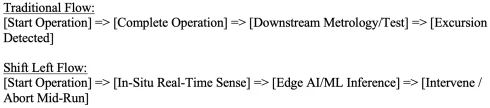
Fig. 1: Shift-left detection can identify yield excursions earlier and support process control. Source: Intel Foundry
Related reading: How Robotics And Intelligent Equipment Control Drive Next-Gen Fab Productivity; Secure Data Sharing Becoming Critical For Chip Manufacturing; Digital Twins: The Cloud’s The Limit; New Frontiers In Fault Detection And Classification.
Source references: Intel Foundry, Onto Innovation, Synopsys, PDF Solutions, Siemens EDA and Lam Research.