Sample No. 0070
Google Playground Turns Game Ideas Into Editable Prototypes Through Prompts
Google Playground lets people build and revise games by describing them in text. Its appeal will depend on how much control creators retain over the results.
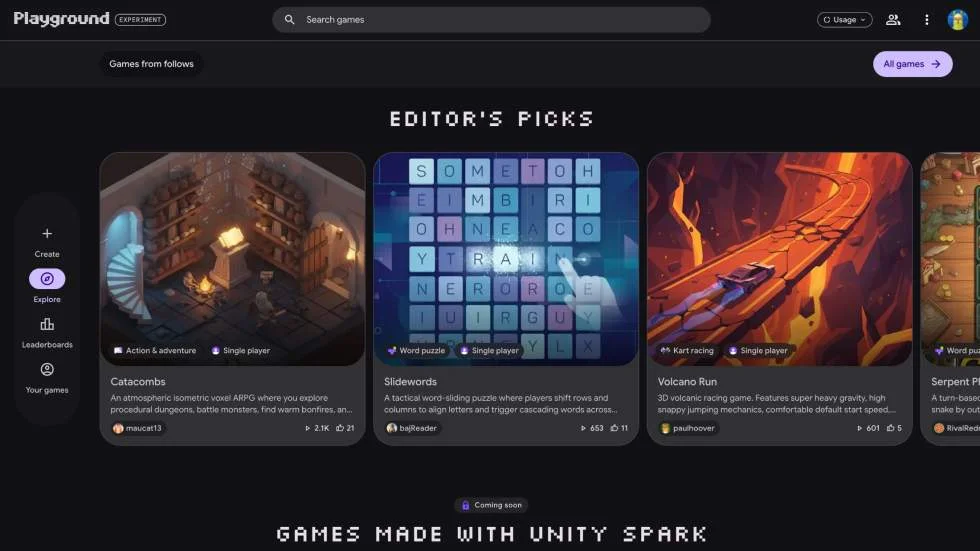
Google Playground’s main promise is a shorter path from game idea to playable experiment: describe what you want, then revise the result through conversation. Google is rolling out access to the website, which is designed for people without coding skills. The practical question is how well that approach supports original play, rather than simply producing a game-shaped first draft.
From description to playable experiment
Playground uses a conversational interface. A creator can start with a blank canvas, adapt a starter prompt, or use guided support to shape a concept. They describe the game they want and its style; Playground generates a version they can test immediately. The process is meant to continue through follow-up requests, including changes to rules, physics, characters, and the environment.
That setup makes iteration the important part of the product. A prompt can establish a rough direction, but the ability to request specific changes gives creators a way to steer what happens next. Someone might adjust how a character moves, change a rule that makes a level too easy, or ask for a different setting. The source doesn’t explain how Playground interprets those requests internally, how much of the result is editable, or whether a creator can inspect and modify underlying code.
Those details matter because “no coding required” can describe very different experiences. A tool might let someone influence a game through natural language while keeping most implementation decisions out of view. That lowers the entry barrier, but it can also make precise behavior harder to control. For early experiments, a quick conversational change may be enough. A creator trying to tune a particular mechanic will need the system to respond consistently and preserve the parts that already work.
Creative direction is the real test
Google’s description presents the creator as directing the work from rough idea to finished product. That’s an appealing model, especially for people who have imagined a game but lack the programming experience to start building it. It also sets a high bar for the interaction: Playground has to understand not just the broad premise, but how a requested change should affect the rest of the game.
For instance, changing a rule can alter the difficulty of a level, while changing movement physics can affect how a character interacts with the environment. These parts are connected. A useful tool needs to make requested edits without turning every revision into a fresh round of corrections. The article’s description says users can test a game and ask for adjustments, but it doesn’t provide examples that show how reliably the system handles that back-and-forth.
Visual style will shape first impressions, too. The catalog includes work that appears to have been made with AI, according to the source. That appearance may be a drawback for people seeking a distinctive visual identity. But presentation is only one part of a game: a compelling mechanic or unusual set of rules can give a simple-looking project a reason to keep playing. The stronger measure will be whether creators can make something with a clear idea and a satisfying interaction, rather than whether its visuals look hand-crafted.
Access and expectations
Access is being tiered according to Google AI subscription level, with people paying more receiving access first. That makes availability part of the product decision: interested creators may need to wait or hold a qualifying subscription before they can try it. The source doesn’t give the subscription tiers, timing, or other access conditions, so the practical cost of trying Playground can’t be assessed from the information provided.
There’s also a difference between generating a playable experiment and delivering a finished game. The source describes immediate testing and conversational edits, but doesn’t say what options exist for saving, sharing, exporting, or publishing projects. Those steps affect whether Playground works primarily as a place to explore ideas or as a tool that can carry a project into wider use. They’re worth watching as Google rolls out access.
What will make it worth returning to
Playground has a straightforward pitch: let people express game ideas in ordinary language, then give them something they can play and refine. That could make experimentation easier for people who would otherwise stop at the concept stage. It could also help experienced makers sketch mechanics quickly, though the source doesn’t describe features aimed specifically at professional development.
The more useful signal will be variety and control. If the catalog fills with familiar templates that are hard to push beyond their starting point, the interface may offer speed without much creative range. If creators can change how a game behaves, preserve good decisions across revisions, and shape a distinct result, the lack of coding could be a meaningful advantage. The promised workflow is easy to understand; the quality of its iteration will determine whether it’s more than a fast way to make a first draft.
Source: Google
Read the original post: Google Playground: Make Your Own Games Without Coding