Sample No. 0066
Google Play Redesign Aims to Make Android Automotive Apps Easier to Find
A redesigned Play Store for cars with Google built-in adds curated browsing, clearer app details and simpler downloads across varied vehicle screens.
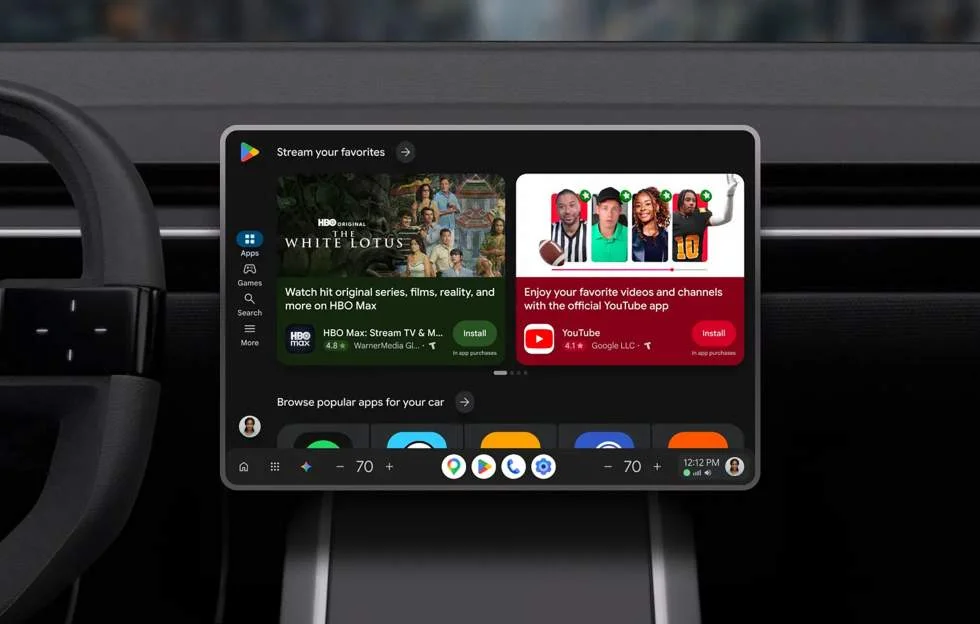
The next Google Play update for cars with Google built-in focuses on a practical weakness: finding and installing apps in a car can be harder than the available catalog suggests. Google says the redesigned store will make browsing clearer, surface more information about apps and offer single-tap downloads. The company expects the update to roll out over the coming weeks.
The change is about the storefront rather than a new operating system or a new app category. Google says its in-car Play catalog already contains more than 700 apps, but the existing experience has made that breadth difficult to discover. A larger catalog only helps drivers and passengers if they can work out what is available, what an app does and whether it fits their needs.
A store built around discovery
The redesigned experience will include featured apps, curated collections and a section for new releases. Google also says app pages will provide more detail, while downloads will take a single tap. Together, those changes address several stages of discovery: seeing suggestions, browsing related options, checking an app’s purpose and installing it.
That sequence matters in a vehicle interface. A store used on a car display has different constraints from one used on a phone: screens vary in shape and size, and people may interact with the interface under conditions where long searches and dense pages are inconvenient. Google says the updated layouts can adapt to the different displays found in vehicles. The company hasn’t described the specific layout rules or how the store behaves across individual screen configurations, so the practical result will depend on how well the design translates to each car.
Curated collections could also reduce the need to know an app’s name before searching. That’s useful when someone is exploring what the system supports, though Google hasn’t said how collections will be selected or how frequently they’ll change. Featured placement can make relevant apps easier to spot, but the usefulness of that approach will depend on whether the suggestions match what people actually want to do in the car.
More apps arriving, with different uses
Google has also named several apps coming to cars with Google built-in: STARZ, Firefox, Ludo King and JioHotstar. Their arrival broadens the set of entertainment and browsing options described in the announcement. The source doesn’t provide launch dates for those individual apps, details about which vehicle models will support them, or a breakdown of where each will be available.
The app names alone don’t establish how each service will work in a vehicle. Availability can depend on a car’s software, display and the app developer’s implementation, and the announcement gives no compatibility matrix. Drivers will need to check the Play Store in their own vehicle after the rollout to see which apps appear and whether they can install them.
YouTube is getting a specific behavior change for parked viewing. The service will let people watch a video while parked, then continue listening to its audio in the background when they begin driving. That offers a way to carry on with audio without keeping video playback on screen. Google hasn’t described the controls, supported content or how the transition will work in every vehicle, so those details will become clearer as the feature reaches cars.
What to look for during rollout
The announcement doesn’t name a start date beyond “over the coming weeks,” nor does it say whether the update will reach all supported vehicles at once. A staged rollout would mean that two cars with Google built-in might show different Play Store versions for a time. The source also doesn’t specify whether owners need to update anything themselves or whether the new interface will arrive automatically.
For app developers, a more visible storefront could make discoverability a more meaningful part of the in-car experience. But the announcement doesn’t describe changes to app submission, ranking or review processes, so there’s no basis for assuming that developers will need to alter their apps. The clearest stated change is to how drivers browse and install what is already available.
The useful measure of this update will be whether people can find suitable apps with less effort and whether the interface remains clear across different vehicle displays. The catalog count gives a sense of scale, but it doesn’t show how much of that catalog drivers will find relevant. As the rollout begins, the details to watch are which vehicles receive it, how app pages and collections work in practice, and whether the YouTube audio handoff behaves as described.
Source: Google. Read the original post: Android Automotive Getting Huge Google Play Upgrade.