Sample No. 0105
TikTok’s “Screentime to Cash” Ads Aren’t a TikTok Pay Program
The pop-ups point to third-party reward apps, not TikTok payments. Here’s how the offers work and what to check before signing up.
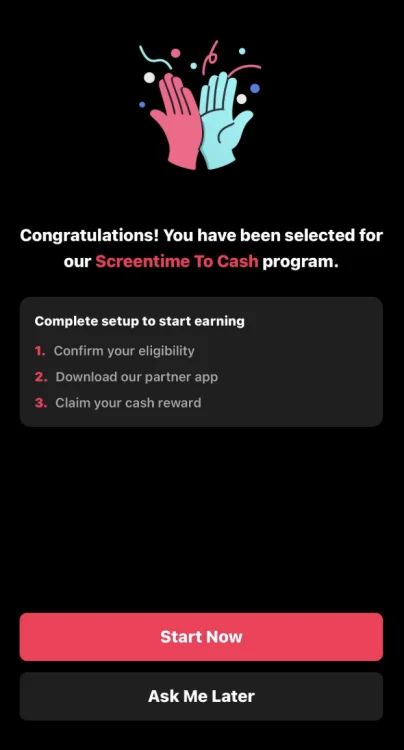
A pop-up promising money for watching TikTok videos may look like a feature of the app, but the resemblance is the point: TikTok says it has no “Screentime to Cash” program and doesn’t pay viewers to scroll or watch. The ads instead appear to steer users toward third-party rewards apps, where the actual task, terms and payout rules sit outside TikTok.
That distinction matters. TikTok does offer an earnings program for eligible creators who publish content and meet its requirements. That is different from an offer that promises cash simply for using the app. TikTok told Mashable it had removed ads and accounts associated with the misleading promotions, and said it removes deceptive material when detected or reported. The company’s action doesn’t, by itself, explain who placed each ad or whether similar promotions could return under new accounts.
What the offer leads to
Mashable found that these promotions typically advertise “Get-Paid-To,” or GPT, apps. Such services may offer small rewards for activities like answering surveys, playing games, watching videos or signing up for other products. The apparent TikTok connection is an ad tactic, not evidence that TikTok runs or backs the reward offer.
The basic business model often relies on referrals. A GPT app may receive a fee when someone downloads a partner app, registers for a service or completes another qualifying action. The rewards app can then pass some of that referral income to users who complete tasks. The exact activity that earns credit—and what counts as completion—depends on the app and its terms. For an overview of how affiliate offers can work, see this case study on affiliate promotion.
Payment usually isn’t triggered by a single video view. Users may need to finish a set of tasks, accumulate enough credits to reach a minimum threshold and then request a payout. That structure makes the headline promise less informative than the conditions underneath it: how points are counted, which actions qualify, and what happens when a task fails to register.
These apps can also earn money through user information and advertising. Some free apps share data with other companies as part of their revenue model; the details depend on the service and its privacy terms. Background on this common app business model appears in guides to apps that pay users to play and how free apps make money. For a user, the practical question is not just whether a reward is advertised, but what information is collected and how it may be used.
Why the ads are hard to trace
Users posted screenshots of the “Screentime to Cash” promotions on social platforms, including one Reddit discussion, another user’s question and a further report of the pop-up. Reports described links to third-party services such as Playful Rewards and QuickRewardz.
Playful Rewards told Mashable that it wasn’t running the ads directly and that a third-party advertising source may have been responsible. QuickRewardz appeared to have been removed from the Google Play store, though Mashable couldn’t establish when it disappeared or who made that decision. The company behind the app, Team Rewardz, had not responded at the time of publication.
This kind of advertising chain can involve a platform, an ad account, an intermediary and the app that receives a user after a click. Each layer can make it harder to identify who created a misleading claim and who is responsible for correcting it. Research on deceptive online advertising has described the wider problem as a network of intermediaries, rather than a single advertiser that can always be removed once and for all; see this report on the ad ecosystem and the related Forrester research.
Can reward apps pay?
Some services do provide small rewards for completed marketing tasks. But a payout promise is not a guarantee that every user will qualify or receive money. Reviews on Trustpilot include complaints from users who say their accounts were suspended after they reached a cash-out threshold. One Playful Rewards review describes an account being locked after its writer accumulated enough credits to request $60. That is a user report, not independent proof of how the service handles every account, but it shows why the rules and support process deserve scrutiny before spending time on tasks.
A sensible check starts with the destination, not the pop-up’s design. Look for the name of the company operating the app, read its payout conditions and privacy terms, and check what information signup requires. If an ad implies a connection to TikTok, verify that claim through TikTok’s own channels rather than relying on logos, notification styling or wording that resembles an in-app message. The same caution applies to offers encountered on other social platforms: an ad’s presence there doesn’t establish that the platform has vetted the advertiser’s claims.
Be especially careful when a task asks for personal details, app downloads or permissions before explaining how a reward is earned. Review whether the service describes data sharing and whether the payout threshold is realistic for the tasks you’re willing to complete. Reporting has also raised concerns about reward-app terms that may permit information sharing or unwanted calls; the relevant source material can be found in this filing.
The useful takeaway is straightforward: “Screentime to Cash” is not a TikTok payment feature. Any money on offer comes, if at all, from a separate service with its own tracking, eligibility and payout rules. Treat the apparent TikTok branding as a warning to verify the source before installing an app or sharing information.