Sample No. 0086
Libido Treatments: What Evidence Supports Medications, Toys and Gummies?
Desire varies with health, relationships and life stage. Experts weigh medications and everyday options against the weak evidence behind many libido gummies.
Libido products promise a convenient fix for a problem that rarely has one cause. Desire can shift with age, stress, relationships, pregnancy and menopause, so a supplement marketed as a universal boost deserves skepticism. Doctors and sex researchers point to a more practical starting point: understand what has changed, then choose an approach that fits the person and the evidence.
Desire doesn't follow one pattern
Libido covers a person’s interest in sex and intimacy, their thoughts about it and their desire to pursue it, says Dr. Melinda Lukens, an OB-GYN and co-director of the University of Chicago Medicine Center for Women's Integrated Health. It can change across a woman’s life, shaped by factors that include relationship changes, stress, trauma, pregnancy and postpartum recovery, perimenopause and menopause.
That variation matters because there’s more than one way to experience desire. Dr. Laurie Mintz, a licensed psychologist, certified sex therapist and sex expert for LELO, distinguishes between spontaneous and responsive desire. The first is the familiar, immediate sense of wanting sex, often accompanied by early physical signs of arousal. It’s also the model most often depicted in popular media.
Responsive desire works in a different order: sexual activity or intimacy begins first, and desire may follow. People also have sex for many reasons besides feeling aroused. In a 2007 study, participants named 237 reasons; attraction to a partner and the expectation of physical pleasure ranked above feeling horny, which came in seventh.
Mintz says spontaneous desire often declines with age or in long-term relationships. For some people, learning that desire can emerge during intimacy helps. That may mean considering sex before feeling an urge, rather than waiting for the urge to appear. It’s an option, not an obligation or a substitute for addressing pain, distress or relationship problems.
Start by working out what's changed
Lukens and Mintz both stress that desire is shaped by several factors, so treatment should begin with a conversation, usually with a clinician. Lukens asks what specifically concerns the patient, how long it has been happening and why they want to address it now. She also asks about the relationship, communication with a partner, orgasm and the patient’s broader sexual history.
She may use the Female Sexual Function Index, a questionnaire covering desire, arousal and satisfaction, to help clarify the situation. Depending on the answers, support might involve a therapist, a sexual health professional or another mental health professional. Lukens also recommends Mintz’s book, A Tired Woman's Guide to Passionate Sex.
Medication may come up when someone has a safe relationship, enjoys sex and intimacy, and wants help getting started. But a prescription won’t resolve every cause of low desire. Mintz cautions against treating relationship unhappiness with medication. For age-related changes, she suggests first discussing responsive desire and options such as scheduling intimacy. Some people still miss spontaneous desire after trying those approaches; Mintz says medication may be useful for them.
Options with evidence behind them
Mindfulness and therapy
Mintz’s first suggestion for desire concerns is often psychological support, including mindfulness during sex and learning how responsive desire works. These approaches can help someone focus on the experience and understand their own pattern. If they want to explore medication, she recommends speaking with a sexual medicine physician.
Testosterone
Testosterone is not FDA-approved for women, though Lukens and Mintz describe it as an option for some postmenopausal women. Lukens says about 40 percent of women in the cited research saw improvement beyond placebo. She views it as one possibility after other approaches have been tried, rather than a cure-all. A clinician can discuss whether it suits an individual patient.
Vyleesi
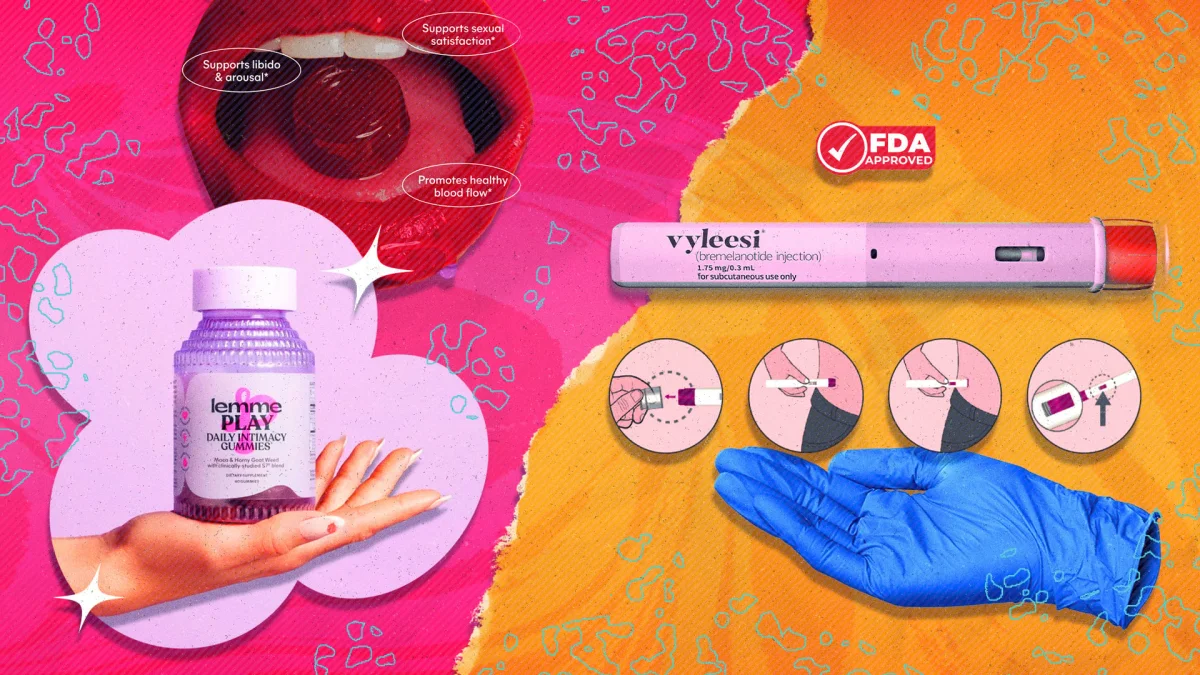
Vyleesi, or bremelanotide, is an FDA-approved injection for premenopausal women. It’s taken around 45 minutes before sexual activity, with a limit of one dose in 24 hours and eight doses per month. The source reports no safety data for use during pregnancy and advises reliable contraception.
The measured benefit appears modest. In one study, around 24 percent of people who received bremelanotide had a rise of more than 1.2 points in their desire score, compared with 18 percent on placebo. The difference in the number of satisfying sexual events wasn’t significant in the initial comparison, though a later analysis found a higher share of such events among people taking the drug.
Vyleesi can raise blood pressure temporarily and lower heart rate. Other reported side effects include nausea and hyperpigmentation, with a higher risk for people with darker skin. People with high blood pressure should avoid it, as should people taking naltrexone. Unlike Addyi, it doesn’t have the same interaction with alcohol.
Addyi
Addyi, or flibanserin, is an FDA-approved daily pill. Lukens describes its benefit as modest: it may increase satisfying sexual experiences by around half an event per month. Dizziness and fatigue are common side effects. Alcohol can interact with Addyi and cause low blood pressure, so people taking it shouldn’t drink.
Cannabis, vibrators and erotica
Mintz says research links small doses of cannabis with higher sexual desire and performance; higher doses are associated with the opposite effect. Studies also suggest vibrators may increase desire as well as satisfaction. Erotic literature has been linked to increased desire and satisfaction compared with placebo. These findings make the options worth discussing, but they don’t guarantee a result for any one person.
Why libido gummies deserve scrutiny
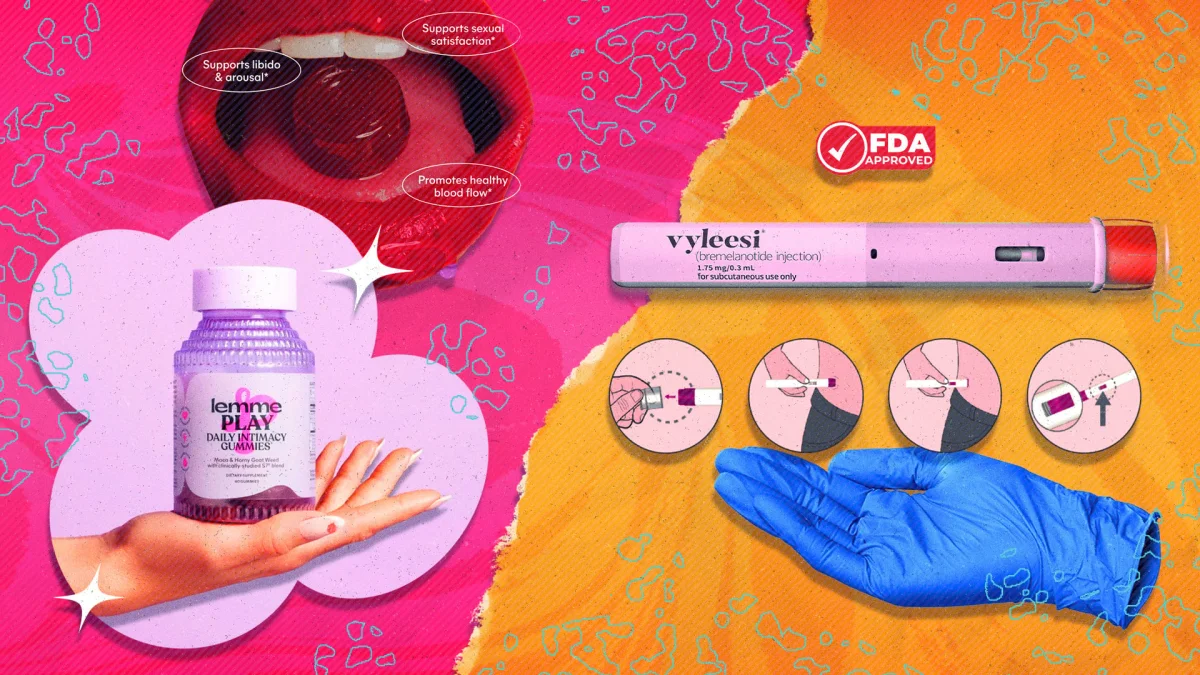
Products such as Lemme Play Gummies, from Kourtney Kardashian-owned brand Lemme, are marketed for daily intimacy. The listed ingredients include ashwagandha, maca root, nitric oxide and horny goat weed. Mintz says ashwagandha is the only one of those ingredients with clinical trials; maca has some suggestive evidence, while nitric oxide affects blood flow to tissues rather than desire. She says horny goat weed hasn’t been studied for this use.
That makes a blend difficult to assess: an ingredient with some evidence doesn’t establish that the finished product works. Mintz favors FDA-approved medication or products supported by clinical trials published in scientific journals. Even ashwagandha may not be appropriate for everyone; she says people with thyroid issues should avoid it and advises checking with a doctor.
Lukens points out that supplements don’t face the same premarket checks for effectiveness and safety as FDA-approved medications. A person might feel a change through expectation—the placebo effect—but that doesn’t remove the financial cost or the possibility of unwanted effects from an ingredient.
More openness, less pressure
Lukens has seen more women raise questions about desire over the past three to five years. She welcomes greater openness about sexual health, while warning that online messaging can replace old shame with a new expectation that women should want more sex. Social media claims that a pill or supplement will restore someone’s younger libido oversimplify a personal, changing experience.
Dr. Jaclyn Siegel, a research fellow at the Kinsey Institute, argues that selling products to “fix” a supposedly broken sex drive can distract from circumstances that affect desire, including multiple jobs, childcare, unequal domestic work and pain during sex. Those conditions call for attention to the person’s life and health, not just another product.
There are medical and nonmedical ways to address desire, but the useful first step is to identify what’s behind the change. For anyone weighing a product, the evidence, possible side effects and personal circumstances matter more than an influencer’s promise. And reducing pressure to feel desire on demand may itself change the conversation.