Sample No. 0187
Sony ECM-AX10 Adds Spatial Audio Recording to a Phone-Connected Mic
Sony’s $249.99 ECM-AX10 plugs into a phone and records spatial, binaural or stereo audio, aimed at creators who want the surrounding sound in their videos.

Sony’s ECM-AX10 is built for creators who want a video’s surroundings to sound like part of the scene. The $249.99 microphone plugs directly into a phone, uses four microphone capsules and offers three recording modes, including Ambisonics for spatial audio. That makes it a more specialized tool than the clip-on microphones typically used to isolate a speaker’s voice.
Sony introduced the microphone on Oct. 8, and it is available for preorder. The company describes it as the first microphone for smartphones certified for Eclipsa Audio. Its central pitch is a direct connection and a recording setup intended to capture the sound around the phone, rather than a separate transmitter and a mic clipped to the creator.
Three ways to record a scene
The ECM-AX10’s four omnidirectional capsules feed three recording modes. Ambisonics uses all four capsules to record spatial sound for immersive production, including Eclipsa Audio. Binaural mode is intended for two-channel headphone listening, while stereo produces conventional two-channel audio that works with a wider range of speakers.
Those modes serve different listening contexts, and the choice matters after recording. Ambisonics is the option for creators who want to preserve a sense of direction and space for compatible playback. Binaural is aimed at headphones. Stereo is the more familiar choice for general video playback. The microphone doesn’t make those formats interchangeable: creators need to decide how viewers are likely to listen and whether their editing workflow can handle the recording they choose.
Sony offers a Spatial Audio Video Tool app for editing captured footage and sound. That gives the mic a software component as well as the hardware, though the available details don’t specify the app’s editing features or what devices and workflows it supports. Those are practical questions for anyone deciding whether spatial recording will fit into an existing production process.
The body weighs 24 grams and connects over USB-C. A built-in accelerometer detects the microphone’s tilt so the audio can stay aligned with video as the phone changes orientation. That could help when switching between portrait and landscape recording, though the source doesn’t describe how the alignment behaves in every app or recording setup.
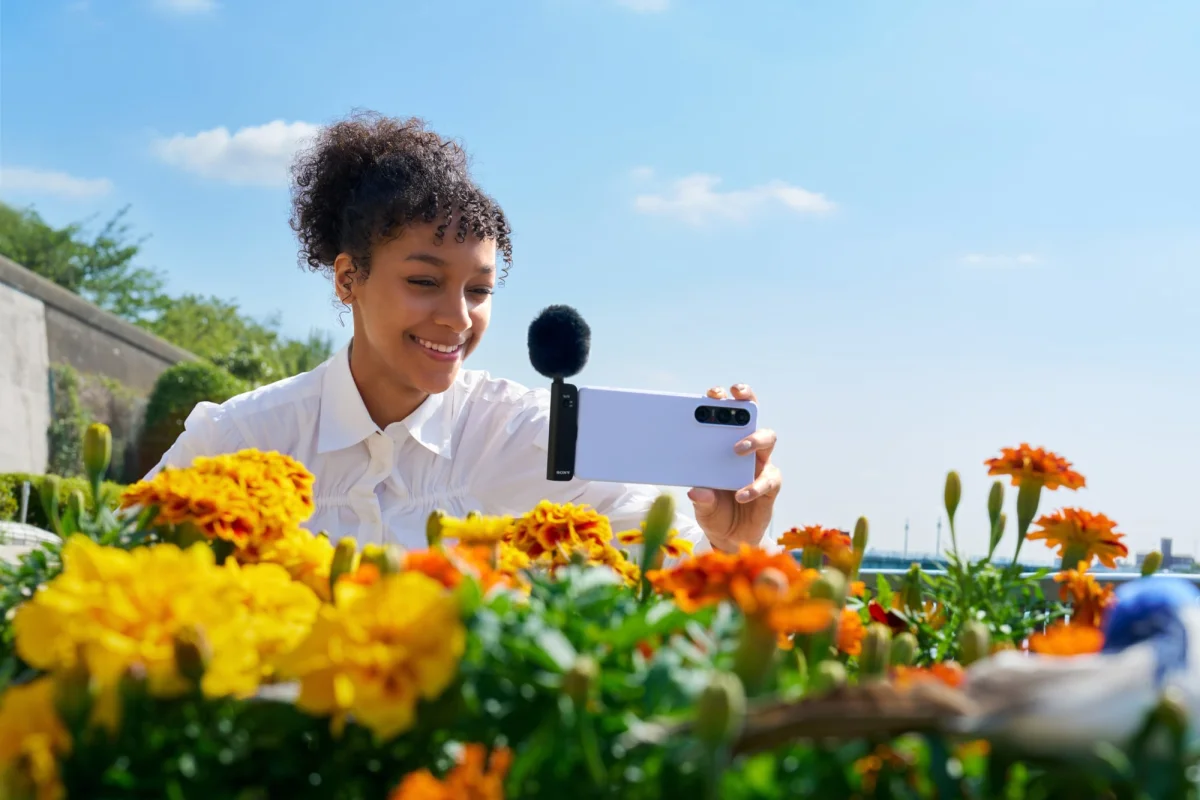
The ECM-AX10 includes a wind screen for outdoor recording. Credit: Sony
Designed to stay on the phone
Traditional wireless creator kits often have a phone receiver and one or more separate microphones. Sony takes a simpler physical approach: the ECM-AX10 attaches to the phone over USB-C, so there’s no separate receiver to carry and no mic to clip onto clothing. Its 3.5mm headphone output lets the user monitor audio, and a peak-level meter offers a quick way to check recording levels.
Controls on the mic include a switch for spatial or stereo recording, a selfie-mode switch for front- and rear-camera alignment, an ATT switch for loud-sound protection and a Noise Cut filter. The supplied accessories are a wind screen, an extension USB-C cable and a cold-shoe microphone holder. Together, those features point to a device intended for recording on location, where orientation, wind and changing sound levels can complicate a take.
That use case includes concerts, performances, sporting events, travel and city walks, where ambient sound contributes to the story. Sony’s example shows a phone recording a music session with the mic attached.
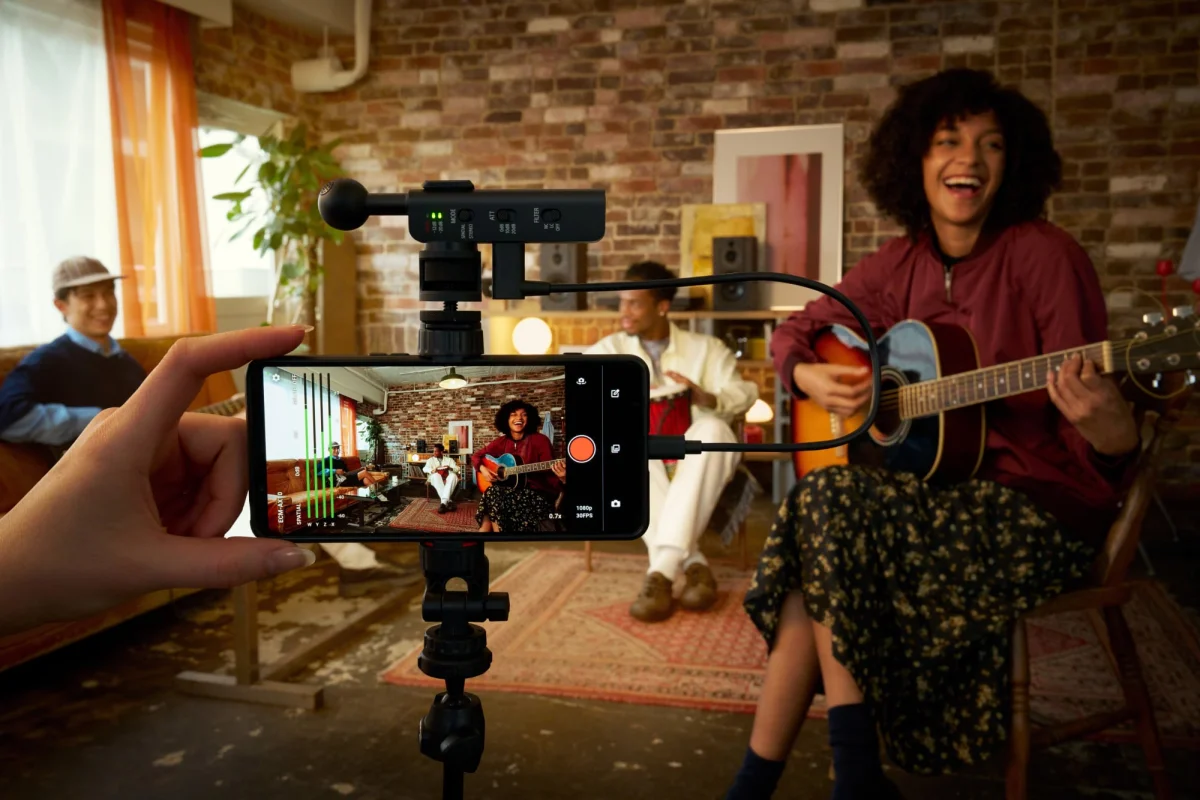
The ECM-AX10 is intended to capture the broader sound of a live music session. Credit: Sony
Who should consider it
The ECM-AX10’s price and recording options make the most sense for creators who have a specific reason to capture the sound around them. A travel video may benefit from environmental detail; a performance recording may need a sense of space that a voice-focused mic is designed to reduce. In those cases, having Ambisonics, binaural and stereo modes in one phone-connected mic gives creators room to choose a format for the finished video.
For indoor talking-head videos, the extra spatial capabilities may go unused. The DJI Mic Mini and Rode Micro are named as lower-cost alternatives for that kind of work. The Sony’s value depends on whether its spatial formats and phone-first design solve a real need in the creator’s setup.
The microphone is listed at $249.99 through  Sony, B&H Photo Video and Amazon. Before ordering, creators should check phone compatibility and confirm that their editing and playback setup supports the format they plan to use. The key question is whether spatial capture will shape the finished work; if it will, the ECM-AX10 offers a compact way to add it to a phone-based kit.